

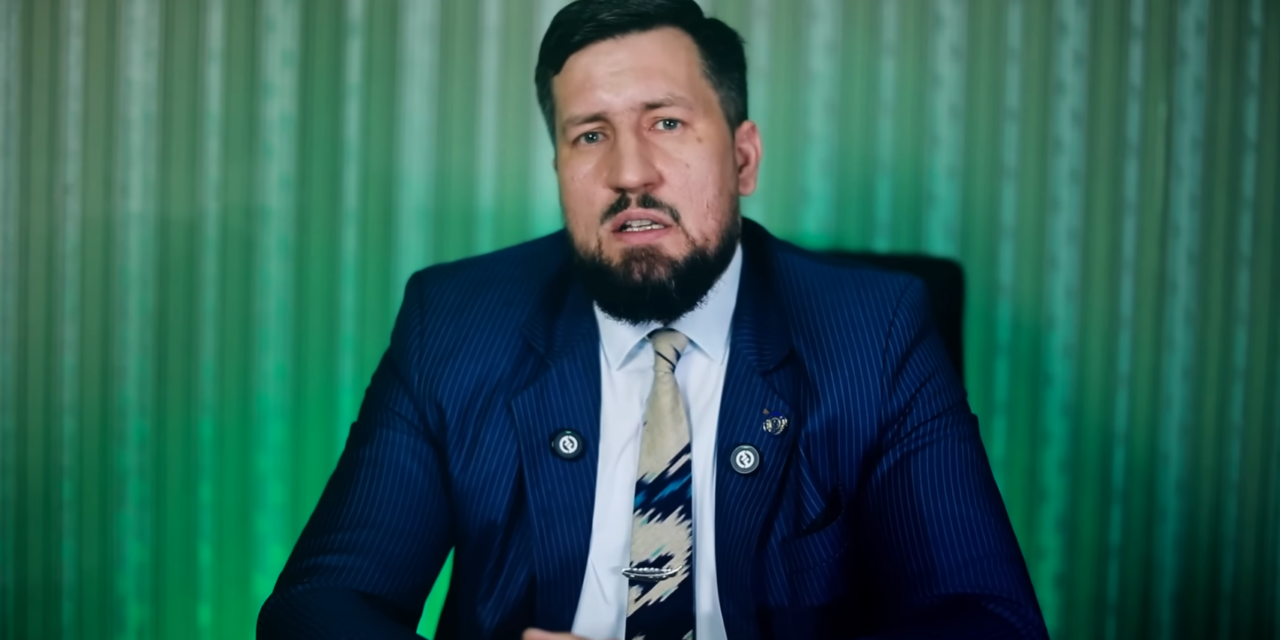
An appeals court in Tashkent has upheld a court decision to revoke the license of lawyer Allan Pashkovskiy, according to the Hook Report.
Pashkovskiy was accused of violating professional ethics in a video message addressed to President Mirziyoyev in which Pashkovskiy spoke about the fabrication of a criminal case against his client and interference in the work of the courts and the legal profession.
However, the representative of the Ministry of Justice was unable to specify the nature of the alleged violation—either during the initial court hearing or at the appeal. When questioned by Pashkovskiy and members of the defense, the representative stated that he had no information about the case and had not even watched the video.
Pashkovskiy intends to appeal the court decisions at the Supreme Court of Uzbekistan.
Allan Pashkovskiy practiced law for more than 16 years and, until recently, headed the Department for the Protection of Professional Rights at the Bar Association of the Republic of Uzbekistan. His career came under intense pressure following his defense of former State Security Service employee Valijon Rakhmanov, who allegedly was tortured in detention. Pashkovskiy was accused of violating professional ethics and subsequently stripped of his license—effectively depriving him of the right to practice law. Pashkovskiy went from defender to defendant.
According to the Hook Report, Pashkovskiy’s client, Valijon Rakhmanov, had held a senior positions within the State Security Service. Pashkovskiy stated that during Rakhmanov’s tenure, he uncovered a large-scale corruption scheme, and damage to the agency and the state budget estimated at “tens of millions of dollars.”
Instead of investigating these allegations, State Security officers detained Rakhmanov himself in February 2024. Pashkovskiy asserted that investigators tortured and physically threatened his client. On January 9, 2025, Valijon Rakhmanov was convicted of treason and sentenced to 16 years in prison.
At Rakhmanov’s appeal hearing, Pashkovskiy pointed to numerous procedural violations during the investigation, including:
- refusal to conduct a medical examination after a second defendant (identified as R. Matyakupov) was also allegedly tortured with an electric shock device.
- denial of the defense to access case materials—two days were allotted to review seven volumes comprising approximately 2,000 pages and video recordings, without permission to make copies.
All motions submitted by the defense were rejected.
During the trial, remarks were issued against Pashkovskiy for using the words “guys” and “wonderful lawyer” in his defense speech, which were deemed violations of professional ethics without explanation.
In total, four remarks were issued—two additional ones for his “smiling face” and for “tapping his knuckles on a plastic box.” The presiding judge of the appeals court subsequently appealed to the Bar Association to take disciplinary action against Pashkovskiy and another lawyer, Vladimir Nikitin.
On April 25, 2025, the qualification commission decided to suspend both lawyers for four months. They were not allowed to review the case materials or defend their own interests. The hearing lasted approximately 30 minutes.
In May 2025, Allan Pashkovskiy recorded a video message calling on law enforcement agencies to conduct a proper investigation into Valijon Rakhmanov’s case. He pointed to the lack of evidence supporting the charges and the authorities’ failure to investigate allegations of torture, emphasizing the contrived nature of the accusations against the lawyers.
However, the appeal resulted in new proceedings. This time, the Ministry of Justice and the Bar Association demanded the complete revocation of Pashkovskiy’s license—effectively supporting the suppression of the alleged corruption scheme.
On December 1, 2025, the Tashkent Interdistrict Administrative Court held an open hearing on revoking Pashkovskiy’s law license. The hearing lasted several hours, most of which was taken up by the defense’s arguments.
Pashkovskiy was again denied proper access to the case materials which he received only a few days before the hearing after they had been sent to an incorrect address that had no connection to him.
The prosecution—represented by the Ministry of Justice and the Bar Association—appeared confident from the outset. Their statements lasted only a few minutes and consisted largely of unsupported claims, including allegations that Pashkovskiy had received money to record his video, sought to “discredit” the country, or disclosed state secrets.
During the proceedings, it became clear that the representatives of the authorities had not even watched Pashkovskiy’s video message that formed the basis of the accusations. When asked to identify specific passages that allegedly violated professional ethics, they provided no answers.
Hook Report quoted Pashkovskiy as saying, “The law on appeals by individuals and legal entities clearly states that criticism or persecution of appellants in any form is prohibited. I could be doing my usual professional work—providing legal assistance—but I am unable to do so because I am being persecuted for acting within the framework of the law.
Despite the fact that I have nothing to do with military matters, my case was sent to the military prosecutor’s office, which declared the video a disclosure of state secrets and an act of treason. ‘If we complied with the law even 50 percent of the time, we would live well’—you yourself cited this figure,” he said, addressing a representative of the Bar Association, who later described these words as treason.
The Ministry of Justice has six types of forensic linguistic examinations it could conduct to demonstrate precisely where and how any violation occurred. Instead, in today’s constitutional Uzbekistan, government representatives do not even consider whether they have grounds for prosecution.
There are currently around 50 lawyers in Tashkent whose professional activities have been suspended or terminated for dubious reasons. Any one of you may need legal assistance tomorrow—but will you receive it?”
Despite the defense’s arguments and the absence of substantiated claims from the prosecution, Judge Azamat Yakubov ruled to revoke Allan Pashkovskiy’s law license.
Meanwhile, President Shavkat Mirziyoyev has announced that 2026 will be declared a period of emergency measures to combat corruption in government agencies.
Starting in the new year, all government agencies will have a deputy head responsible for compliance and internal anti-corruption control in an effort to regulate and oversee activities. These new officials will be responsible for identifying dishonest employees in the system, strengthening control over the expenditure of budget funds, and working to prevent embezzlement and abuse of authority and will report directly to the president.
President Mirziyoyev has stressed that no agency will be exempt from oversight, including law enforcement agencies, tax and customs authorities, the banking sector, ministries, local governments, and large state-owned companies.
“Those who think that no one will touch them because they have a position and a title, are mistaken. Everyone is equal before the law,” said President Shavkat Mirziyoyev.