
Since early 2025, independent media outlets and the social media accounts of journalists, political commentators, and civil society activists from Uzbekistan have faced an escalating campaign of digital attacks by seemingly government-aligned actors.
These attacks exploit vulnerabilities in technology companies’ content moderation and complaint-handling systems. Anonymous or fraudulent accounts submit false copyright claims, fabricated reports of users’ deaths, and other misleading information. As a result, platforms suspend accounts or remove content, often without adequately verifying the claims, explaining their decisions, or providing access to a swift and effective appeals process.
In some cases, malicious actors have allegedly hacked media channels and uploaded prohibited content, including child sexual abuse material, apparently with the aim of having the channels permanently removed.
The principal targets are independent journalists and commentators, including those living outside Uzbekistan, who criticize the government over human rights violations, corruption, nepotism, and the concentration of political power.
The cases documented below demonstrate how platform safeguards intended to protect users and intellectual property can be weaponized to suppress legitimate journalism and public-interest commentary. Although the perpetrators have not been identified in most cases, the coordinated nature of the attacks, their focus on government critics, and their timing in relation to sensitive publications suggest that they form part of a broader effort to suppress critical voices.
Prohibited Material Used to Shut Down Independent Channels
In at least two cases, attackers uploaded pornographic material, including images of children, to independent media channels. This content was subsequently used as grounds for shutting down the Eltuz YouTube channel and the “Asliddin Kamol” Telegram channel.
The Shutdown of Eltuz YouTube Channel
On the morning of April 28, 2025, three police officers arrived at the Stockholm apartment of Uzbek journalist Kudrat Babajanov who works in exile. The police informed him that he was suspected of producing and distributing child sexual abuse material on social media.
Police searched the apartment and seized Babajanov’s digital devices. He was then taken to a police station for questioning and informed of his right to a public defender.
Babajanov was told that the investigation had been opened following a cyberattack on the Eltuz YouTube channel, which he administered and which had approximately 800,000 subscribers.
During the night of February 4, 2025, attackers hacked the channel and uploaded prohibited content, including child sexual abuse material. Babajanov attempted to remove the content manually before YouTube blocked the accounts. On the same day, he reported the hacking and the upload of prohibited content to the Stockholm police and requested a criminal investigation.
On February 13, the police informed him that the crime could not be investigated because there were no traces or other evidence that could identify those responsible.
The hacking followed a series of attacks against the Eltuz channel in January and February 2025. During that period, individuals and organizations purportedly based in Tashkent submitted dozens of copyright complaints against the channel. By the time the prohibited material was uploaded, Eltuz had already received two copyright strikes and was in the process of appealing them.
Following the February 4 attack, YouTube removed the channel. It has never been reinstated.
In July 2025, Swedish police changed Babajanov’s status from “suspect” to “victim” and returned the confiscated devices. In February 2026, the police closed the case without identifying those responsible.
The Shutdown of “Asliddin Kamol” Telegram channel
Opposition commentator and refugee Asliddin Kamol left Uzbekistan at the end of 2022 because he feared arrest. According to Kamol, his social media accounts have since been subjected to repeated attacks.
On February 2, 2025, Ogabek Jumanazarov, one of the administrators of the “Asliddin Kamol” Telegram channel, was arrested in Tashkent. He was subsequently charged with encroachment on the constitutional order of the Republic of Uzbekistan.
Kamol believes that after Jumanazarov’s arrest, Uzbek security services accessed the channel through his devices, as he was able to establish that the unauthorized logins originated from devices showing their current location as “Tashkent, Uzbekistan.”
On February 3, approximately 20 pornographic images were uploaded to the channel. Telegram subsequently shut down the channel, and Kamol lost access to it.
He regained control of the channel in May 2025 after providing Telegram with evidence showing that it had been accessed without authorization from Tashkent through the arrested administrator’s device.
“Declared Dead” on Facebook
In August and September 2026, Facebook converted the accounts of at least six prominent Uzbek commentators into memorialized accounts after receiving false reports that the account holders had died.
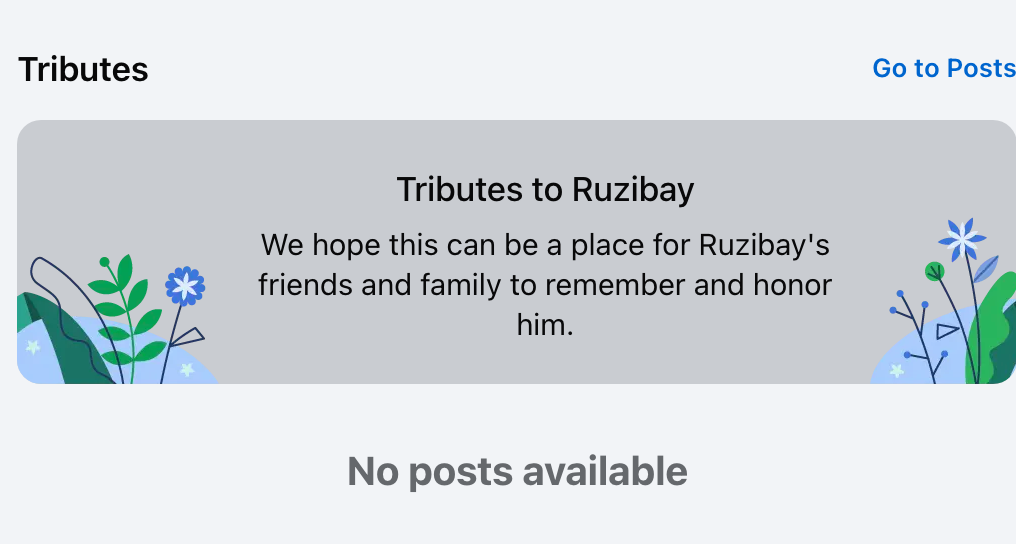
Restoring an account placed in memorialized status has proved extremely difficult. Journalists Alexei Volosevich and Galiya Ibragimova regained access only after international organizations intervened. The accounts of political commentator Alisher Ilkhamov and journalist Ruzibay Azimiy remain memorialized despite repeated appeals confirming that they are alive and that the reports of their deaths are false.
Alisher Ilkhamov
On August 27, 2026, London-based political analyst Alisher Ilkhamov discovered that Facebook had memorialized his account after the platform received false information about his death. He submitted three appeals but has so far been unable to regain access.
This was not the first time his account had been targeted. Facebook suspended it in mid-April 2026, and Ilkhamov regained access only on August 3, following the intervention of an international human rights organization.
On August 27, shortly before again losing access to his account, Ilkhamov published a post about Saida Mirziyoyeva, the president’s eldest daughter and head of the Presidential Administration. In the post, which prompted widespread online discussion, he wrote: “Saida is concentrating unlimited power in her own hands.”
Galiya Ibragimova
On September 11, 2026, Facebook memorialized the account of journalist Galiya Ibragimova, who lives in Moldova and has written about Saida Mirziyoyeva on multiple occasions. Unknown individuals had falsely reported her death to Facebook. Her account was restored on September 19 following an appeal by a human rights organization. Ibragimova described the emotional impact of the attack:
“Of course, what upset me most during those days was what my mother had to go through. She would visit my page, see that Facebook had ‘buried’ me, and become frightened. She would say: ‘Galya, let’s remove that message. Let’s do something. This is horrible.’ Removing it turned out to be far from easy, and I had to spend a long time explaining to my mother that ‘digital death’ was only digital. But it is still very difficult for parents.”
Ibragimova said the attacks on her social media accounts intensified after she published an article examining how Uzbekistan had changed in the decade since the death of its first president, Islam Karimov and the policies pursued by his successor, Shavkat Mirziyoyev. Ibragimova believes that the attacks are connected to her critical reporting on the president and his daughter, Saida Mirziyoyeva.
Alexey Volosevich
On August 5, 2026, Facebook memorialized the personal account of Tashkent-based journalist Alexei Volosevich without conducting any apparent verification, even though he is a public figure and had recently published new posts and comments. The account of the independent online media platform AsiaTerra, which was linked to his personal account, was also automatically deactivated.
“Getting the account out of memorialized status turned out to be not merely difficult, but nearly impossible,” Volosevich wrote. “In theory, the verification process was supposed to be simple. All I had to do was submit a form and upload a photograph of myself holding an identity document. However, nothing worked. As soon as I clicked the ‘Select Files’ button, the message ‘File not selected’ appeared, followed by: ‘We were unable to process your request. Please try again later.’ I could not upload a single JPG photograph from either my phone or my computer, even though I tried different browsers. The verification process proved impossible to complete.”
Both accounts were eventually restored two weeks later after Volosevich contacted a human rights organization specialized in digital access rights.
Ruzibay Azimiy
On September 6, 2020, Facebook memorialized the account of Ruzibay Azimiy, a former journalist living in exile, which he still not able to access. Azimiy is a prominent critic of the Uzbek president and had built a substantial following on his Facebook account.
Umida Niyazova
On August 6, 2026, Facebook suspended the account of Umida Niyazova, director of Uzbek Forum for Human Rights, without warning or explanation of the alleged violation.
The account was restored on September 19 only after human rights organizations intervened. Meta has never explained why it disabled the account.
Abuse of Copyright Complaint Mechanisms
Since early 2026, independent Uzbek media outlets, journalists, and activists have faced a wave of account suspensions based on alleged copyright infringement.
Despite apparent warning signs that the complaints might be fraudulent, Facebook and Instagram accepted them and restricted or suspended the targeted accounts. Appeals were frequently unsuccessful, and some accounts were restored only after international human rights organizations intervened.
After receiving a copyright complaint, the platforms place the burden on the targeted user to prove that the claim is false. In practice, journalists and activists have been forced to defend themselves against large numbers of complaints from unidentified claimants, often without receiving adequate information about the allegations or having meaningful access to the platform’s decision-makers.
The cases reviewed by Uzbek Forum indicate that some complaints were submitted from fraudulent email addresses using the names of real journalists or established media organizations.
For example, a copyright complaint against the Facebook account of exiled journalist Ulugbek Ashur was submitted in the name of Alexei Volosevich, the founder and editor of AsiaTerra, without Volosevich’s knowledge or consent. Volosevich, an Uzbek journalist who was also separately targeted, publicly confirmed that his identity had been unlawfully used to submit the fraudulent complaint.
The systematic use of false or misleading complaints has resulted in the removal of content and the suspension of accounts belonging to dozens of independent media outlets and activists reporting critically on developments in Uzbekistan.
These cases expose serious weaknesses in platform governance. Complaint systems designed to protect copyright holders can be exploited to remove legitimate journalistic content, while ineffective appeals mechanisms prevent those targeted from promptly regaining access to their accounts.
It has not been possible to identify those responsible for these attacks. Because the targets are primarily government critics, there is speculation that computer specialists acting on behalf of the Uzbek authorities may be involved. Commercial content-removal services may also be used.
In August 2026, the Organized Crime and Corruption Reporting Project (OCCRP) reported on an India-based “agency” that charged between US$3,000 and US$5,000 for fraudulent “copyright-claim” services
Alberto Fittarelli, a senior researcher at the University of Toronto’s Citizen Lab, told OCCRP that the abuse of copyright-reporting systems is particularly effective because it is virtually invisible to unaffected platform users. Unlike bot-generated comments or posts, this form of abuse remains significantly underestimated.
“With review systems geared towards accepting a claim based on superficial evidence, it is almost trivial for bad actors to set up and backdate websites so as to claim ownership of a certain content, and to throw the burden of evidence on their victims,” said Fittarelli.
Given the scale of the problem, technology companies must finally strengthen their procedures for verifying copyright claims and reports falsely alleging that users have died, ensure prompt access to human review, preserve evidence of coordinated attacks, and establish emergency response mechanisms for journalists and human rights defenders whose accounts are suspended for politically motivated reasons.
They should also investigate patterns of fraudulent complaints rather than treating each incident as an isolated content moderation dispute. Without such safeguards, systems intended to protect users and copyright holders will continue to be weaponized against journalists and civil society, enabling malicious actors to silence critical voices without a court order, a transparent procedure, or a meaningful opportunity to appeal.