

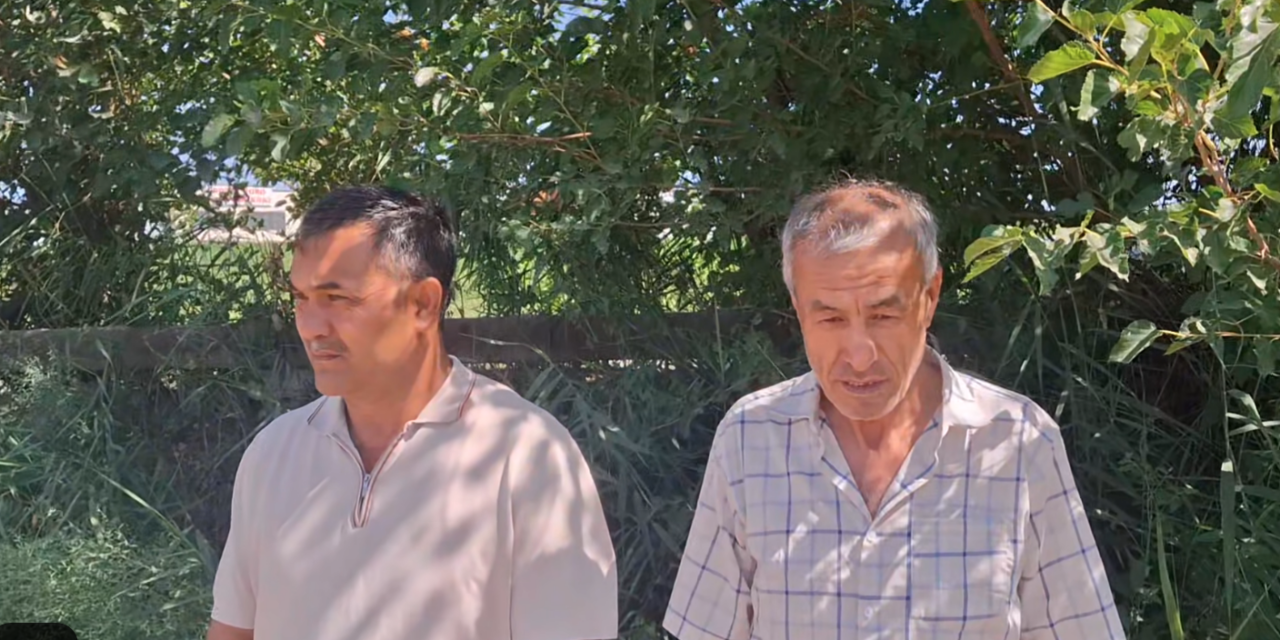
Farmers in several regions of Uzbekistan have recently reported that local authorities are exerting pressure on them to produce inflated quotas of wheat of up to 100 centners per hectare. Farmers are then expected to hand over the surplus wheat that exceeds the amount stipulated in the contracts they have concluded with the state.
According to one media report, this summer farmers in several districts were forced by government officials to sign revised contracts for wheat in which their quotas had been arbitrarily increased.
“If you don’t deliver another 20 tonnes, I won’t let you harvest your crop.”
Komiljon Ergashev, head of the ‘Komil Ergash’ farm in the Olot district of the Bukhara region, explained in a video appeal to the President of Uzbekistan that his farm had exceeded the quota specified in his contract. However, he claims that Nargiza Nematova, the hokim (head of the the local administration) of the Olot district, demanded that he hand over a further 20 tonnes of wheat and, when he refused, ordered that no combine harvesters be allowed into his fields. According to Ergashev, his remaining wheat is now withering in his fields and the delay in harvesting has also prevented him from sowing his second crop on time.
In addition to his farm, Ergashev also owns a bakery and said that he needs the remaining wheat to produce flour and bread. He claims that handing over additional wheat will force him to buy back his own wheat at a higher price in order to keep the business running.
According to farmers interviewed by Ozodlik (the Uzbek language edition of Radio Free Europe/Radio Liberty), the state was buying wheat from them at a price of approximately 3,200 UZS per kilo. The same grain was reportedly sold on the commodity exchange at around 3,500 UZS per kilo, while the grain on the open market was being sold for approximately 4,000 UZS.
Ozodlik reported that it had approached the Olot district administration for comment but received no response regarding Ergashev’s allegations from either the district governor, Nematova, or the head of the Olot district agriculture department, Elor Toshev.
Farmers claim the pressure is coming “from above”
Another farmer, who wished to remain anonymous, told Ozodlik that demands to hand over grain beyond the quota specified in his contracts were not simply initiatives by individual district officials. According to the farmer, the contracts farmers signed in the previous year were terminated and replaced with contracts featuring a significantly higher production quota, without taking into account the actual yield potential of the land. This appears to be in accordance with a Presidential decree to increase wheat yields.
“My original production quota was just over 70 tonnes, but this year it was increased to more than 100 tonnes,” said the farmer.
The presidential decree, adopted in December 2025, set a target of increasing wheat yields to 100 centners per hectare in 2026 through the introduction of intensive agricultural technologies.
The decree states:
The following have been set as the main targets for 2026: (a) an increase in productivity from 50 centners in cotton farming to 100 centners in cereal farming as a result of the widespread introduction of modern, intensive agricultural technologies.
However, according to farmers, the yield target is viewed not as a policy objective but as a mandatory quota, even in cases where producers have not received all the promised financial and technical support.
In an interview with Uzbek Forum, a farmer from the Pop district in Namangan region confirmed that this year farmers in his district were forced to sign contracts with inflated production quotas, as local officials need to report that yields are constantly increasing. “I was able to defend my actual quota because my land has a low yield rating, but not all farmers are prepared to argue. I don’t know how others get out of this situation,” he said.
Conditions are not the same across the country. One farmer from Kokdala in the Kashkadarya region told Ozodlik that the 2026 harvest took place without pressure from the police and that he had signed the contract voluntarily. He attributed the rise in income to favorable weather conditions, the discontinuation of the local cluster system and the payment of market prices for wheat.
Threats and abuse of farmers by local officials persist
Audio recordings attributed to district hokims published by local media in recent weeks, illustrate the continued use of abusive and authoritarian methods against farmers. One of the audio recordings, published on June 24, reportedly features Khalimjon Umarov, the hokim of the Kuva district in the Fergana region. In it, the hokim can be heard insulting a farmer with obscene language and demanding that he voluntarily hand over his land.
“Hey you, you b… don’t you want to talk to me? What the f*** are you playing at? I’ve been looking for you for three days and can’t find you. … Shall I have you locked up right now?! Do you want to be locked up?” said Kuva district hokim Umarov.
The Fergana region administration subsequently announced an internal investigation, but no further information has been provided.
Hokim of Muzrabat district reprimanded for threatening and insulting farmers
On June 15 this year, Uzbek media outlet Kun.uz released a leaked audio recording made during a meeting at the hokimiyat (local administration) of Muzrabat District in the Surkhandarya region. The meeting focused on issues relating to the fulfilment of contractual obligations for the production and delivery of wheat. In the recording, district hokim Abdulla Mamatkulov can be heard using humiliating language to demand that farmers meet their production quotas and deliver the wheat within a few hours.
“Why haven’t you met your quota? If you don’t meet it by 11, I’ll lock you up…”, the hokim said in the recording. Later, he calls one farmer a “asshole”, gives him an hour to meet the quota and threatens to contact the deputy regional prosecutor to have a deadline set for him.
Following the publication of the recording, the Surkhandarya regional administration set up a working group to investigate. Subsequently, the Anti-Corruption Agency reported that Mamatkulov’s behavior had breached the code of ethics for civil servants. As a result, Mamatkulov received a disciplinary reprimand.
Farmers treated as subordinates rather than entrepreneurs
In an interview with Kun.uz, Kamoliddin Ikromov, head of the Agribusiness Association, described the treatment of farmers as a systemic problem. He stated that some officials still view farmers not as independent entrepreneurs, but as brigadier (foot soldiers), who are expected to carry out instructions from above.
Ikromov notes that farmers bear the costs and risks associated with production: they raise funds, hire workers, cultivate the land and carry the responsibility for market fluctuations and adverse weather conditions. Treating them merely as executors of state-imposed quotas, in his view, hinders the development of agriculture.
Ikromov also linked the pressure on farmers to the obligations placed on officials to produce favorable official statistics. When harvests fall short of expectations due to a lack of water, infrastructure, fertilizer or adverse weather conditions, officials may seek to report that the targets have nevertheless been met. As a result, the pressure is passed on to farmers, some of whom are reportedly forced to sell their livestock or mortgage their homes to cover the costs of meeting their grain quotas.
This practice has consequences that extend far beyond the direct losses incurred by individual farmers. The money spent on “fulfilling” inflated grain quotas by having to buy extra wheat on the exchange where the prices are higher, cannot be invested in other inputs and resources for the next farming season. Inflated production figures can also distort government and market decisions. If official reports show that sufficient wheat has been produced, whilst in reality there is a shortage, imports may be arranged too late, potentially forcing the country to purchase grain later at higher prices.
According to Ikromov, officials at various levels may conceal crop failures for fear of criticism, dismissal or disciplinary action. This leads to a chain of inaccurate reporting: if officials report yields of 100 centners per hectare when the actual figures are lower, subsequent decisions on procurement, prices, imports and future production plans will also be based on false information.
Although farmers may not always receive fertilizer, water, machinery or other resources in a timely manner, they are nonetheless forced to purchase inputs at inflated prices through middlemen. However, when yields fall, the blame is often placed solely on the farmer, rather than on failures in other parts of the production system.
In Ikromov’s view, disciplinary measures alone are insufficient to put an end to these abuses against farmers as long as local officials are tasked with meeting state-imposed production targets, and farmers continue to fear losing their land and livelihoods should they refuse to comply with their unlawful demands.