

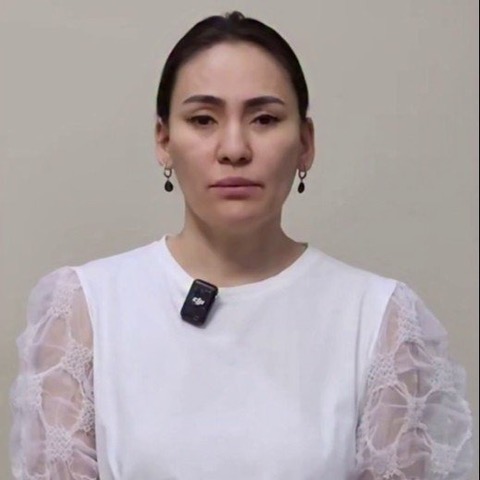
Judge Mukhtarama Turgunova © Kun.uz
The prosecution of four former judges has raised broader questions about judicial accountability and judicial independence in Uzbekistan. At the heart of the case is a critical question: should judges face punishment when their decisions are subsequently overturned by a higher court?
The Tashkent Regional Criminal Court is currently hearing a high-profile criminal case against four former judges of the Tashkent City Criminal Court.
The defendants are former judges Mukhtarama Turgunova, Odilbek Ilhomjonov, and Mirziyod Obidov, as well as Murodjon Mirzajonov, the former deputy head of the Tashkent City Court.
Prosecutors allege that, in late 2025, the three former judges knowingly issued an unlawful ruling, an offense under Article 231 of Uzbekistan’s Criminal Code. Mirzajonov also faces charges under Article 236 for allegedly interfering with the administration of justice.
All four judges were dismissed from their positions in December 2025, then arrested and placed in pretrial detention in January 2026. Three were released on bail in April, while Mirzajonov remains in custody.
Why Were the Judges Arrested?
The criminal case against the former judges stems from an appellate ruling in the criminal case against businessman Akmal Shukurov.
On December 9, 2025, a three-judge appellate panel reduced the sentence imposed on Shukurov, who had been earlier convicted of fraud, hooliganism, and intentionally inflicting grievous bodily harm.
According to the criminal case materials, in March 2025, Shukurov was involved in a violent altercation outside a restaurant and punched a man who had attempted to intervene. The victim sustained life-threatening head injuries, underwent emergency brain surgery, and was placed in an induced coma. Shukurov subsequently left Uzbekistan but was later arrested in Kazakhstan and extradited.
In October 2025, the Mirzo Ulugbek District Criminal Court found Shukurov guilty of fraud, hooliganism, and intentionally inflicting grievous bodily harm, sentencing him to eight years and one month in prison.
On December 9, 2025, the Tashkent City Court’s appellate panel reduced Shukurov’s sentence to four years and one month of restricted liberty and ordered his immediate release.
The unusually lenient ruling prompted intense debate in the media and on social networks. Uzbek media outlet Kun.uz compared the decision with several similar criminal cases and questioned why Shukurov had received a substantially lighter sentence than defendants convicted of comparable offenses.
On December 18, 2025, the appellate ruling was overturned through supervisory review and Shukurov was returned to prison. The judges who had ordered his release subsequently became defendants in a criminal case themselves.
Why Are More Than 50 Lawyers Defending the Judges?
The prosecution has attracted an unusual level of attention within Uzbekistan’s legal community. More than 50 lawyers have joined the judges’ defense team.
In interviews with the BBC‘s Uzbek service, lawyers said it was already extremely difficult within Uzbekistan’s judicial system to secure an acquittal or a reduced sentence, even when the evidence was insufficient to support a conviction. They warned that the prosecution of the former judges could make courts even more reluctant to acquit defendants or impose non-custodial sentences.
The case has also prompted extensive discussion on Uzbek social media. Supporters of the prosecution argue that judges who knowingly issue unlawful rulings must be held criminally accountable. Others warn that prosecuting judges because their decisions were subsequently overturned could seriously undermine judicial independence.
The key question is therefore whether the former judges knowingly issued an unlawful ruling, as prosecutors allege, or whether they are being prosecuted for a judicial decision that should have been corrected through the ordinary appellate or supervisory review process.
The Prosecution and the Defense
The trial opened before the Tashkent Regional Court on July 24, 2026. At the first hearing, defense lawyers challenged the court’s jurisdiction, arguing that the case should be heard by the Supreme Court rather than a regional court. The court rejected the motion and ordered the proceedings to continue.
At the July 31 hearing, the court granted a defense request requiring investigators to disclose an audio recording included in the case file. However, it rejected requests to replace Mirzajonov’s detention with a less restrictive measure.
The court also granted a request allowing journalists and bloggers to record the proceedings using their own equipment.
The defense argues that criminal liability should not arise solely because a higher court subsequently overturns a judicial decision and that disputes over judicial reasoning should ordinarily be resolved through appellate or supervisory review rather than criminal prosecution.
Speaking to BBC Uzbek, lawyer Abdumalik Abdullayev said the case concerns judges’ ability to make independent decisions. Lawyer Muxsinjon Madaminov similarly warned that the outcome could influence how judges approach future cases, particularly those attracting significant public attention.
Petition to the UN Working Group on Arbitrary Detention
In July 2026, the former judges announced that they had submitted a petition to the UN Working Group on Arbitrary Detention. They alleged that their detention and criminal prosecution violated safeguards intended to protect judicial independence. According to the defense, the complaint also raised concerns about pressure allegedly exerted on the defendants during the investigation.
One of the petitioners to the working group, former judge Mukhtaram Turgunova, gave an interview to the human rights defender Gulnoz Mamarasulova in which she alleged that investigators had repeatedly pressured her to testify against former deputy chair Murodjon Mirzajonov. She also claimed that she had been unlawfully placed in the same detention cell as a woman whom she had previously sentenced while serving as a judge. After her release on bail, she said, she was mistakenly detained as a wanted person.
Shortly before the trial began, Turgunova issued a public statement denying wrongdoing by the appellate panel. She argued that judges should not face criminal prosecution solely because a higher court later overturns one of their decisions. She also said that investigators had found no evidence of corruption or illicit financial gain.
“We examined the case lawfully and fairly,” Turgunova said. “If judges can be prosecuted simply because a higher court later overturns their decisions, who can guarantee that ordinary citizens will not face similar unlawful actions?”
Judicial independence does not mean that judges should be immune from accountability when there is credible evidence of corruption, improper interference, or a knowingly unlawful decision. However, the reversal of a judgment by a higher court cannot, by itself, serve as sufficient grounds for criminal prosecution.
The trial is ongoing and its outcome will have implications extending beyond the four defendants. It will test whether Uzbekistan can ensure accountability for alleged judicial misconduct without weakening the ability of judges to reach independent decisions, including decisions that are unpopular, controversial, or ultimately overturned.