
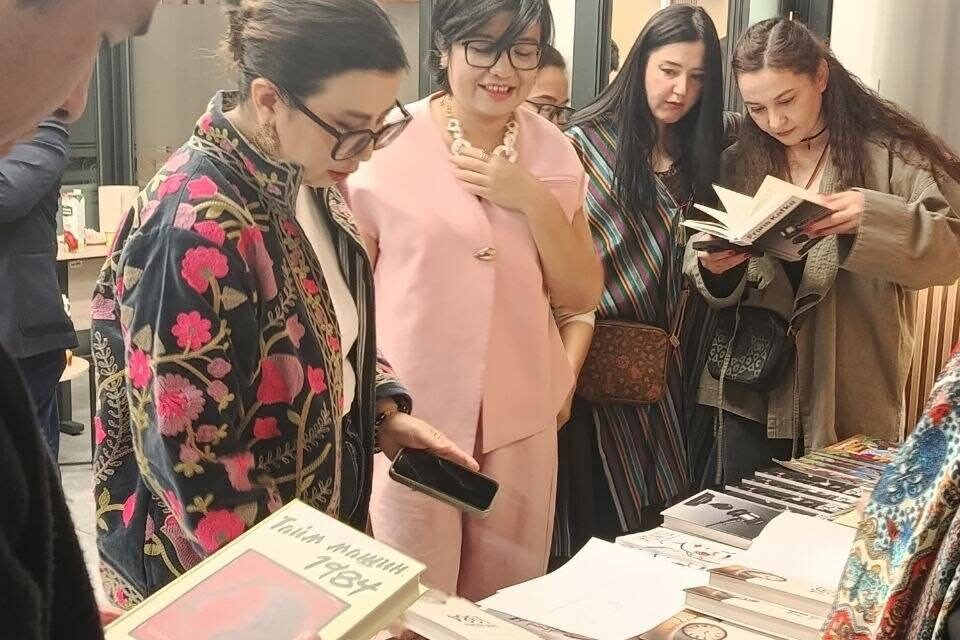
On November 5, 2026, police officers from Tashkent’s Chilanzar district together with a state inspection official who introduced himself as Farhod (full name unknown), raided the offices of Alp Publishing and seized a total of 5,274 books. These included 2,488 copies, in Latin and Cyrillic scripts, of exiled Uzbek journalist Shukhrat Babajanov’s novel “Time Machine: 1984”, and 2,786 copies of the Uzbek translation of Indian philosopher Jiddu Krishnamurti’s “Freedom from the Known”. Both books are widely available in other countries, including in Europe and the US.
According to the seizure protocol, drawn up by major Hasan Qodirov of the Counterterrorism Department of the Chilanzar district police’s Operational Search Service, the books were seized “following operational search activities,” “in the presence of attesting witnesses,” and “pending a lawful decision.”
The report does not specify what suspected offense prompted the seizure. It contains no information about a literary expert assessment or a court decision banning the books. The publisher remains unaware of which passages allegedly justified the seizure or what suspected offense is being investigated.
Alp Publishing’s owner, Alisher Fayzullaev, posted on social media that, during the visit, he was told that the publisher’s books had been discussed on September 10, 2026, apparently at Uzkomnazorat, Uzbekistan’s Inspectorate for Control over Informatization and Telecommunications under the Ministry of Digital Technologies. Despite being the publisher’s director and editor, he had not been invited to that discussion.
A week before the seizure at the publishing house, police raided two bookshops selling Babajanov’s novel and confiscated several dozen copies.
Reflecting on his decision to publish the novel, Fayzullaev wrote:
“From the outset, I understood that publishing Shukhrat Babajanov’s “Time Machine: 1984” was a major risk. Many people close to me warned me about it, some out of genuine concern for me. I think you already understand why: it is because of the author.”
Shukhrat Babajanov worked for 19 years at Radio Ozodlik, the Uzbek service of Radio Free Europe/Radio Liberty. He was forced to leave Uzbekistan in 2021 after the authorities opened a criminal case against him over alleged “document forgery”. Before leaving, he headed a private television station whose live studio broadcasts were critical of the government. The TV station’s license was revoked in 1999, forcing it to close. However, after Shavkat Mirziyoyev came to power in 2016, Babajanov was allowed to visit Uzbekistan and publish his novel about Tashkent.
Fayzullaev emphasized that his decision to publish the book was based on its literary merits. He described the novel as a work set in Tashkent in 1984 that connects different historical periods and places while exploring science, social life, and human relationships. He also noted that the book carries an 18+ age label.
The publisher rejected any suggestion that Babajanov’s book was connected to terrorism or religious extremism. “If I have made a mistake somewhere, point it out to me. I personally analyzed and edited these works and considered them worthy of publication,” he wrote on his Facebook page.
The publishers do not know whether an expert examination has been ordered, by whom and when, which institution has been assigned to conduct it, or what questions have been put to the experts.
Pressure on Publishers and Self-Censorship
Uzbek poet Tillaniso Eshboeva, who translated Krishnamurti’s “Freedom from the Known” into Uzbek, described a broader problem facing publishers and the lack of clear criteria governing objections to literary works by regulatory authorities.
She questioned the use of phrases such as “alien to our spirituality” and “incompatible with our values”. “These are very vague concepts. Are they defined anywhere, and are those definitions set out in law? Or are we going to ban books and tear out their pages on the basis of an interpretation that happens to occur to someone at a particular moment?”
Tillaniso cited her own poetry collection, “Qon” (Blood), as an example. She says that in 2022, the newspaper Milliy Tiklanish (National Revival) published a lengthy article calling for her book to be banned because it considered the content to be erotic. Tillaniso rejected that interpretation and noted that the book carried an 18+ age label and was therefore clearly intended for an adult audience.
She also said that, while working in publishing, she had witnessed editors paying fines following objections to particular scenes in books. In her experience, fear of penalties pushes editors to cut and alter literary works. “Editors are constantly wondering whether a sentence might offend someone or provoke the anger of a particular group of readers.”
This uncertainty encourages self-censorship, forcing publishers and editors to assess works according to the anticipated reactions of officials and particular groups of readers, rather than in accordance with government guidelines. As a result, readers receive abridged texts or lose access to works in Uzbek altogether.
Countering Extremism and Protecting Freedom of Expression
The books were seized two days after amendments to Uzbekistan’s legislation on countering extremism entered into force. The law, which took effect on November 3, 2026, replaces the term “religious extremism” with “extremism” and provides for an electronic register of extremist organizations and materials. The Ministry of Justice will maintain the register, which is to be published on the ministry’s website and made publicly accessible.
Under the law, state bodies responsible for countering extremism must submit requests to designate material or a source as extremist to the Prosecutor General’s Office. Each request must include an expert assessment confirming the presence of extremist content. If the Prosecutor General or a deputy accepts the supporting documents, they must apply to the Supreme Court for a ruling declaring the material or source extremist.
However, based on recent developments, it appears once again, that Uzbekistan’s laws are on paper only and that implementation is arbitrary. The result is an erasure of literature and a downward spiral in literary quality for fear of censorship.