

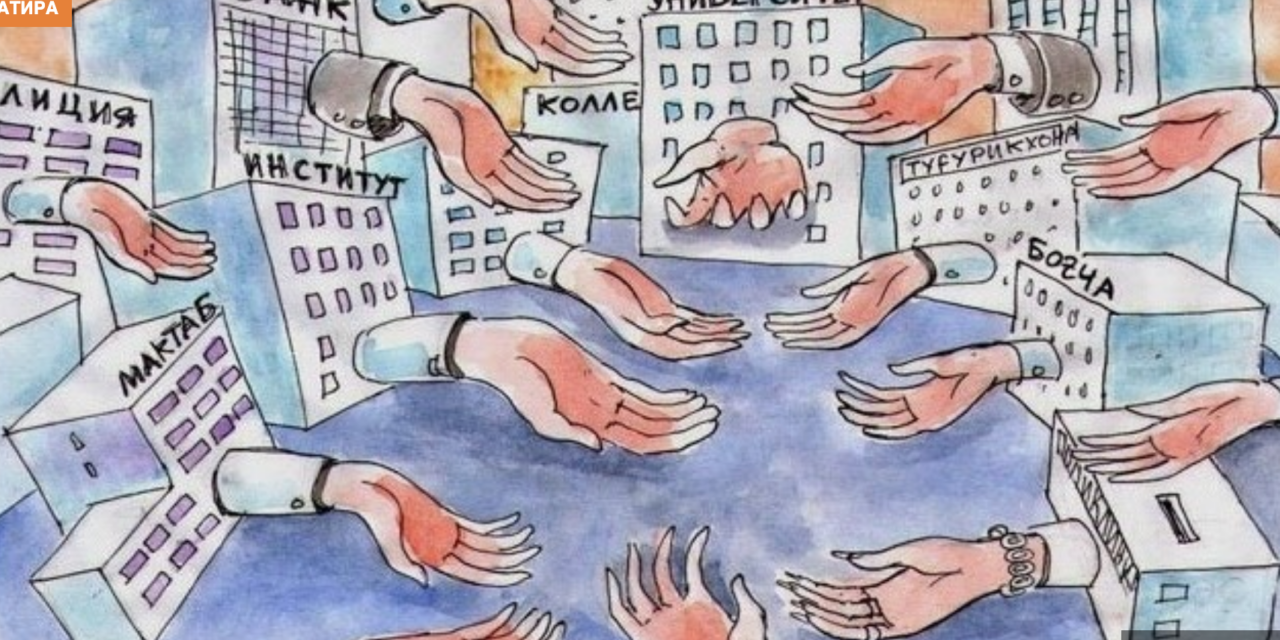
Declaring a “state of emergency” in the fight against corruption for 2026, Uzbekistan’s President Shavkat Mirziyoyev promised that neither rank nor position would shield offenders from accountability. Criminal prosecutions and arrests of officials at various levels have been initiated against the backdrop of this campaign. Yet high-profile cases have not resolved the problem of selective enforcement: some officials receive lengthy sentences, others retain access to senior positions after serious allegations, and some return to public office following their convictions and commit further crimes. As host of the Convention of State Parties in 2027, Uzbekistan has a lot more to do to ensure its credibility as a party to the UN Convention Against Corruption.
Ravshan Rajabov: From torture to anti-corruption official
A recent appeal by Dilfuza Ibodova has renewed questions about selective accountability for officials convicted of serious crimes. In her appeal to the president and the Prosecutor General’s Office, Ibodova asked how Ravshan Rajabov, convicted in a torture case involving the death of her brother Ilhom Ibodov, came to hold a senior position in the anti-corruption department of the state-owned gas supply company Hududgaz Poytaxt.
The case of the Ibodov brothers from Bukhara became one of Uzbekistan’s most prominent prosecutions of security officials for torture. In August 2015, security service officers detained the two businessmen, 44-year-old Ilhom and 48-year-old Rahim Ibodov. They were accused of economic crimes related to their business activities. One month after their arrest, Ilhom died in custody.
In their official response to the UN Committee against Torture, the Uzbek authorities acknowledged that state officials, acting in collusion with prisoners, had severely tortured both brothers. They also confirmed that the Military Court delivered its verdict on June 22, 2018. According to Ozodlik (the Uzbek service of Radio Free Europe/Radio Liberty), several officials involved in the torture received prison sentences ranging from 14 to 18 years.
Ravshan Rajabov, a former deputy head of the Bukhara Regional Tax Inspection, was found guilty of torture under Article 235 of the Criminal Code and abuse of authority resulting in death under Article 301 and was sentenced to 16 years in prison. According to the verdict, the court applied a parliamentary amnesty adopted to mark Constitution Day, reducing his prison term by a quarter.
The government’s online anti-corruption platform, E-Anticor, now lists Rajabov as head of the Department for the Efficient Use of Material Resources and Implementation of Anti-Corruption Policy at the Hududgaz Poytaxt branch of Hududgazta’minot, a state-owned company responsible for distributing and supplying natural and liquefied gas.
In her appeal, Dilfuza Ibodova stated that after years of fighting for an investigation, her family want those convicted to serve meaningful sentences. Upon learning that Rajabov now holds a senior anti-corruption position at a major state-owned enterprise the family decided to seek explanations from the authorities.
The return of officials convicted of corruption and embezzlement to management positions is not unusual in Uzbekistan. The following examples represent only some of the known cases.
Ulugbek Sultonov: From conviction for extortion of farmers to head of district agriculture
In September 2025, media reported that two deputy hokims (governors) of Buston district in Andijan region had been detained on suspicion of accepting bribes as a group acting in collusion, under Article 210 of Uzbekistan’s Criminal Code.
Later, the court found that the two officials had acted together to demand one million UZS (approximately $80) per hectare from farmers, supposedly to fulfil the district’s 2025 “export plan” on behalf of their farms. One of those convicted, Ulugbek Sultonov, who was responsible for agriculture in the district, threatened farmers with the loss of their land if they refused to pay. He was sentenced to six years in prison for extorting money from farmers. Despite his appeal in October 2026, the Andijan Regional Criminal Court upheld his sentence.
The judgment revealed that Sultonov had previously served as deputy hokim of Asaka district in Andijan region and was responsible for agriculture and water management. In January 2023, he was sentenced to three years and one month of restricted liberty and banned from holding certain positions for two years. In 2024, he was granted conditional early release from the remaining portions of both penalties. Although it is not known exactly what he was convicted for, the fact that he was barred from holding positions involving financial responsibility suggests that the charges involved embezzlement or theft of public property.
Despite his previous conviction, the Ministry of Agriculture announced Sultonov’s appointment as deputy hokim of Buston district for agriculture and water management, and head of the district agriculture department in January 2025.
Yusuf Tursunov: From embezzlement to reinstatement as governor
According to media reports, on March 4, 2021, the Navoi City Court found Yusuf Tursunov, head of the city’s public amenities department, guilty of embezzlement and forgery. The case concerned streetlights purchased at inflated prices, with losses established at 1.053 billion UZS (approximately $85,000). Tursunov was sentenced to three years of corrective labor, arrest of 10 percent of his salary, and an 18-month ban on holding managerial positions or positions involving financial responsibility. In August 2021, an appeal reduced the corrective labor sentence to two years and seven months.
Despite the conviction taking effect, Tursunov continued to lead the department for some time. His dismissal became public only in October 2021. In March 2023, a court granted him conditional early release from the remainder of his corrective labor sentence.
On June 21, 2023, Navoi’s new hokim, Muratkhan Egamkulov, approved a decision reappointing Tursunov to the same position. The following day, on June 22, Tursunov was dismissed, officially at his own request. Although his resignation was given as the formal reason for his departure, the sequence of events suggests that media attention prompted the authorities to reconsider the appointment.
Abdujabbor Egamberdiev: From criminal conviction to trade union leader
The former hokim of Andijan district was convicted in February 2023 of arbitrary exercise of authority, negligence and abuse of office. Egamberdiev received two years of corrective labor and a two-year ban on holding positions involving financial responsibility. In January 2024, a court released him early from the remaining additional penalty. In December 2024, he became chairman of the Andijan Regional Council of the Federation of Trade Unions. Although trade unions are formally nongovernmental organizations, in practice they are closely integrated into the system of state administration.
The reappointment of public officials with criminal records for misconduct has also been acknowledged at the state level. During a parliamentary discussion of an anti-corruption report, MP Umida Rahmonova stated that people who had previously committed corruption offences had been rehired into public service, and that 566 of them had gone on to break the law again.
Behzod Musaev: From mass poisoning of children to migration corruption scheme
The career of Behzod Musaev, former director of the Migration Agency under Uzbekistan’s Cabinet of Ministers, deserves separate attention. He has held senior government positions since before 2010.
In 2018, Musaev was reappointed first deputy chairman of the State Tax Committee. According to media reports, his name was on the Interior Ministry’s wanted list at the time. The notice listed suspicion of embezzlement, concluding transactions contrary to the interests of the state, concealing foreign currency, fictitious entrepreneurship, tax evasion and abuse of office. Following media coverage, the interior ministry removed the wanted notice without providing any explanation.
In November 2021, Musaev became Minister of Health. During his tenure, children suffered mass poisoning linked to the Dok-1 Max cough medicine scandal which killed 68 children. Musaev offered his condolences to the families, but the tragedy did not interrupt his career. On December 30, 2022, he became Minister of Employment and Poverty Reduction and in September 2024, he was appointed head of the Agency for Migration.
In May 2026, the Agency for Migration became the focus of a major corruption scandal involving the recruitment of Uzbek citizens for work in South Korea. According to the Department for Combating Economic Crimes under the Prosecutor General’s Office, applicants were unlawfully charged between $7,000 and $12,000 on top of official fees. Investigators estimated that the total amount could have reached $90 million.
Azizbek Toshtemirov, the former head of the agency’s representative office in South Korea, publicly accused Musaev of involvement in the scheme and of using subordinates to carry out personal errands. According to Toshtemirov, he was required to regularly send expensive food and other goods to the agency’s director.
Despite these public allegations, available reports indicate that Musaev himself was not investigated. In September 2026, four former State Security Service officers convicted in the “Korean Case” received prison sentences of between 15 and 16 years.
Musaev was dismissed as director of the Agency for Migration in September 2026. On October 9, Uzbek media reported that he had been appointed head of the Vatandosh Public Foundation, which supports compatriots abroad. The foundation receives state subsidies and funding through government programs.
This succession of appointments raises questions about political accountability and the remarkable ability of some officials to remain in positions of influence. Particularly serious concerns arise when officials convicted of serious crimes return to public office and abuse their powers again, while others continue to receive senior appointments despite unresolved corruption allegations.
The credibility of Uzbekistan’s anti-corruption campaign depends not only on arrests and convictions, but also on who is entrusted with public responsibility afterwards. Furthermore, the importance of the media in shedding light on these cases cannot be overstated. In an environment of increasing retaliatory convictions of bloggers and activists for their critical reporting, those reporting on the corruption of officials should be commended for their bravery.