

Reports of police violence, threats and restrictions on lawyers’ activities raise serious concerns about the protection of legal professionals in Uzbekistan and their clients’ access to an effective defense.
Nazirjon Abdukhafizov: Lawyer alleges assault by police
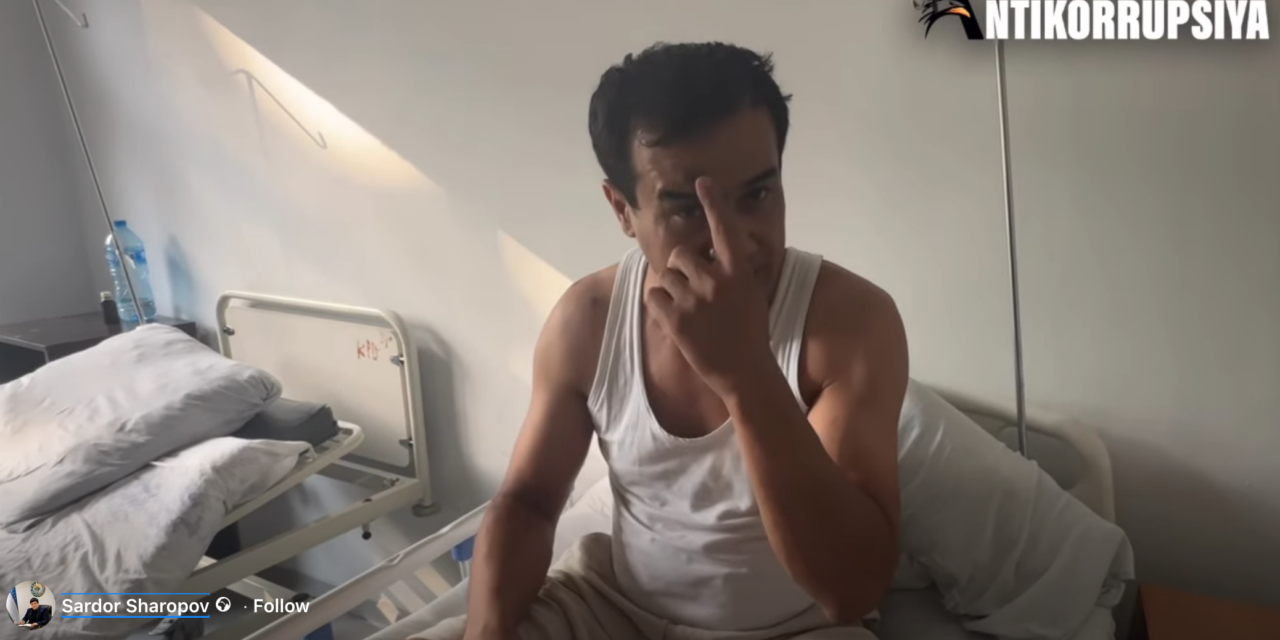
In a video statement recorded from hospital, Tashkent lawyer Nazirjon Abdukhafizov said he was beaten at the Yashnabad district police station on August 27, 2026. That day, he had accompanied two clients to meet an investigator named Asliddin and submit additional materials concerning their allegations of fraud. According to Abdukhafizov, his clients had expressed their lack of confidence in the investigating police officer whom they said was biased against them despite evidence supporting their allegations.
The dispute over the handling of the case that day escalated to the point that Abdukhafizov feared for his safety. He called the police emergency number to report the threats against him and complain about the investigator’s conduct.
Abdukhafizov alleges that he went into the courtyard as he felt increasingly threatened and that a police officer named Farhod, who was standing nearby, approached him and began choking him. According to the lawyer, seven or eight other officers then joined in, beating and kicking him.
Abdukhafizov said that he was struck on the forehead with a baton, affecting his vision, and that he briefly lost consciousness. He described being struck again and kicked from behind, causing him to fall. When he tried to reach his car, several officers allegedly dragged him back into the police building and placed him in a temporary detention cell.
There, he said, officers warned him that drugs could be “found” on him if he did not keep quiet. They also told him that he had to write a statement confirming that he had no complaints about their conduct if he wanted to be released. When Abdukhafizov said that he needed medical attention, the officers agreed to call an ambulance but demanded that he tell the medical staff he had high blood pressure, make no complaints about his treatment and “smile”. “Because of the pain and suffering caused by the blows, I was forced to agree and write the statement,” he said.
After his release later that day, Abdukhafizov set off for his workplace but lost consciousness on the way. “I woke up in the City Clinical Hospital N. 16,” he said. “I don’t know how long I was unconscious for.” According to a medical examination, he sustained injuries to his head, shoulder, elbow, knees, back and kidney area.
In response to the lawyer’s appeal, the Chamber of Advocates issued a statement saying it had contacted the Prosecutor General’s Office and the Ministry of Internal Affairs. An internal security unit of the Tashkent police then launched an internal investigation into the allegations of physical violence and the lawyer’s detention, and its findings will be made public.
Kashkadarya: Lawyer reports violence while seeking access to his client
On June 10, 2026, lawyer Lazizjon Sharipov went to the Karshi city police department to meet his client, human rights defender Javokhir Muminov, who had been arrested on suspicion of extortion.
In a complaint submitted to the Karshi city prosecutor that day, Sharipov stated that Nodir Elmatov, the head of the temporary detention facility where Muminov was being held, demanded that Sharipov leave his mobile phone in Elmatov’s office. According to Sharipov, Elmatov then forcibly grabbed his wrist and tried to drag him to an area of the facility without CCTV cameras. The incident left a large bruise on the lawyer’s wrist.
In his written statement, Sharipov asked the prosecutor to investigate, citing interference in his professional duties and the use of physical force.
On June 12, however, an investigator from the Karshi city prosecutor’s office wrote to the regional Chamber of Advocates requesting an internal investigation into Sharipov’s conduct. The letter cited an allegation by Elmatov that Sharipov had caused a disturbance in response to what Elmatov described as “a lawful demand” to surrender his phone before meeting his client. Elmatov accused Sharipov of breaching professional ethics and denied using physical force.
Rather than providing a substantive response to the lawyer’s allegations, the prosecutor’s investigator referred the complaint against Sharipov to the Chamber of Advocates and requested that it report the findings of its inquiry.
Uzbek Forum previously reported on allegations that Sharipov’s client, Javokhir Muminov, a human rights defender, had complained of being tortured after his arrest on June 5, 2026. According to Muminov, Karshi police officers beat him, placed a bag over his head and taped his mouth shut despite his complaints that he was struggling to breathe. Ambulances were called repeatedly as his condition deteriorated. A forensic medical examination documented multiple bruises and abrasions consistent with the time he was in police custody.
These allegations also highlight the importance of the ability of lawyers to document their encounters with law enforcement officials. Mobile phone recordings may provide crucial evidence when lawyers themselves face threats or physical violence. Another incident, involving Bukhara lawyer Zavkiddin Amonov, illustrates this concern.
Bukhara: Lawyer prevented from leaving after meeting his client
In a video statement published on June 5, 2026, lawyer Zavkiddin Amonov said he had met his client, Jahongir Gafarov, the previous day. Gafarov, a senior healthcare official, had been arrested in connection with an alleged bribe and was being held at Pre-Trial Detention Facility No. 4 in Bukhara.
According to Amonov, Gafarov told him that several law enforcement officers had beaten him for 30–40 minutes the day before meeting his lawyer. The officers allegedly demanded that he testify against senior officials in Bukhara region.
Amonov said he had filmed visible marks on his client’s body. In his public appeal, he asked the prosecutor’s office, the Ministry of Internal Affairs and the Ombudsman to help secure an urgent forensic medical examination.
Amonov also reported that he himself had been unlawfully prevented from leaving Pre-Trial Detention Facility No. 4. After meeting his client, Amonov was told that the facility’s first deputy head wanted to speak to him. However, when he tried to leave the building, he found the metal gates were locked. The officer at the security post told him that the deputy head had ordered staff not to let him out.
Amonov published a short video which showed him standing behind the locked gate while an officer explained that his superior had instructed him not to release him. Later in the recording, the deputy head appeared and after realizing that Amonov was filming the encounter on his phone, ordered the gate to be opened.
In response to the lawyer’s allegations, the Ombudsman’s office announced that it had reviewed reports of torture and coerced confessions at Pre-Trial Detention Facility No. 4 in Bukhara region and that its regional representative had visited the facility and interviewed the detainee. According to the statement, a preliminary inquiry had been opened into certain employees, and a forensic medical examination had been ordered. The Ombudsman said it would continue to monitor the proceedings.
At the time of writing, no public information was available about the outcome of the inquiry into the torture allegations or any investigation into the attempts to prevent Amonov from leaving the detention facility.
Kashkadarya: Lawyer reportedly held inside police headquarters
A similar incident reportedly took place in Karshi city at the Kashkadarya regional police headquarters on August 24, 2026. A video published by a local Telegram channel shows an unnamed lawyer standing behind a metal turnstile asking a police officer to let him leave. The officer refuses to open the turnstile, despite the lawyer telling him that he has no legal right to detain him. Instead, the officer asks the lawyer to stop recording.
According to the description of events accompanying the video, the lawyer had submitted a request seeking the removal of the investigator handling his client’s case, citing a lack of confidence in the investigator. Guards were then allegedly instructed not to let him leave the building. He was reportedly held there for approximately 30 minutes.
Commenting on the incident, Tashkent lawyer Abdumalik Abdullayev asked: “Who has the right, and under which law, to prevent a lawyer from leaving a police building?” Abdullayev called for an impartial investigation, including a review of CCTV footage and identification of whoever issued the order. He argued that the incident raised concerns about personal liberty and interference with lawyers’ professional work, despite a presidential decree from April 21, 2025, intended to address obstacles facing lawyers. Abdullayev stressed that obstructing a lawyer also undermines citizens’ right to a defense.
Legal safeguards offer limited protection in practice
The protection of lawyers in Uzbekistan is enshrined in the Constitution, the Law on the Legal Profession, the Law on Guarantees of Lawyers’ Professional Activities and Social Protection of Lawyers. These provisions prohibit interference, pressure and obstruction of legal assistance, and guarantee confidential communication with clients.
The Presidential Decree from April 21, 2025, instructed the Ministry of Justice, together with the Chamber of Advocates, to submit a bill to the Cabinet of Ministers within three months “to address obstacles preventing lawyers from providing quality legal assistance”.
In May 2025, the Ministry of Justice and the Chamber of Advocates reportedly discussed a draft bill aimed at removing such obstacles. At the time of writing, public confirmation that the bill had been submitted could not be found.
Despite legal safeguards, lawyers in Uzbekistan remain poorly protected in practice. While defending their clients’ rights, they themselves need protection from pressure and abuse. But who will provide that protection when the threats and obstruction come from law enforcement officials themselves? Without independent investigations and accountability, Uzbekistan’s public commitments to rule of law have no credibility while both lawyers and the people whose rights they defend, remain vulnerable to arbitrary abuse.