
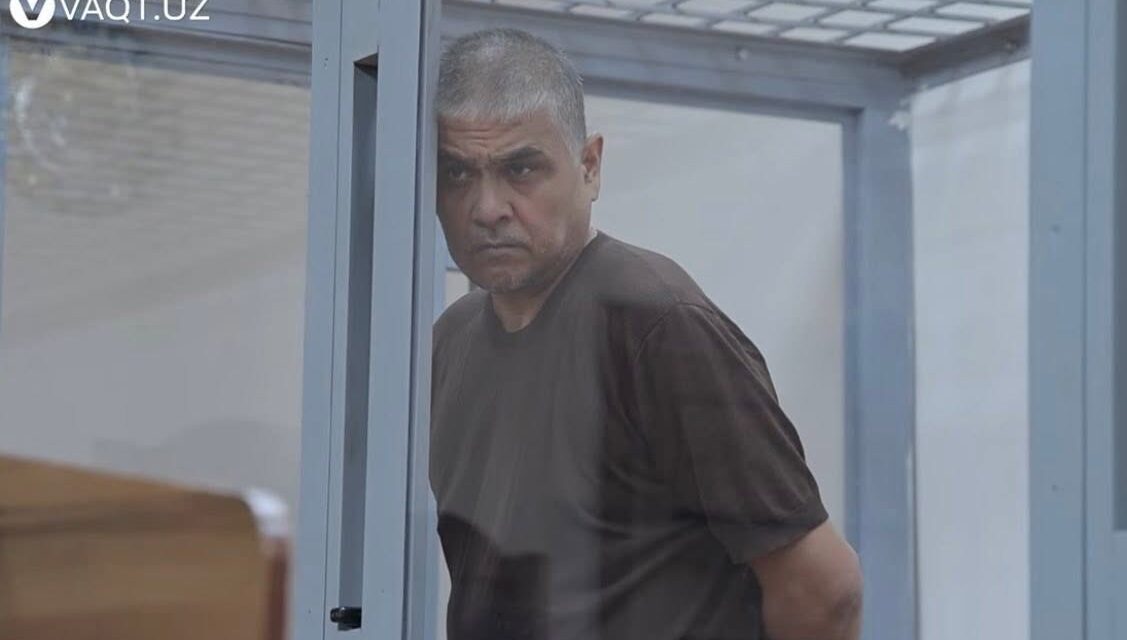
On October 5, 2026, a district criminal court in Jizzakh region sentenced Sirojiddin Adilov, one of Uzbekistan’s most prominent bloggers, to four years in prison. He was ordered to serve his sentence in a settlement colony, a form of open prison.
His conviction rests on three incidents involving payments he received from the head of a construction company and two women who approached him for assistance. Adilov denies any wrongdoing. He maintains that he provided agreed services, incurred travel expenses while preparing media reports, and helped people to hire lawyers.
Adilov, 46, the director of “Sirojiddin Media” LLC and a father of four, has been in custody since March 11, 2026. His audience across social media platforms totals approximately one million, including more than 900,000 YouTube subscribers. During his trial, he stated that he had worked as a social and political blogger for 13 years and produced more than 3,000 videos.
Adilov is also known for extensively covering the case of Gulirano Kosimova, a school principal in Fergana region. In April 2025, police officers beat her, forced her to strip naked, and filmed her during an operation orchestrated to frame a local tax inspector. The footage of her ordeal was subsequently circulated online. Adilov’s reporting is believed to have contributed to her efforts to secure partial justice and hold the police officers accountable. In November 2025, the district police chief and his deputy were sentenced to four years in prison, the same four-year prison sentence imposed on Adilov.
Abdurakhmon Tashanov, director of the human rights organization Ezgulik, participated in Adilov’s trial as a public defender. He reported that procedural violations had marred the case against the blogger from the outset. According to Tashanov, two lawyers traveled from Tashkent to Samarkand for the pretrial detention hearing but were denied permission to participate despite presenting documents authorizing them to represent Adilov. Instead, Adilov was represented by a state-appointed lawyer.
The initial allegations against Adilov included fraud and payment of a bribe, although the latter charge was dropped during the investigation. Tashanov alleged that investigators then added an extortion charge to keep the blogger in pretrial detention. Uzbek Forum reviewed the court verdict, which states that the allegations of two complainants concerned their dealings with Adilov two and three years prior to his arrest. According to the verdict, both filed complaints with the police only after the blogger’s arrest and, during the trial, were unable to explain why they had waited several years to do so.
Payment for media promotion
The court found Adilov guilty of extorting 12 million UZS (approximately $1,000 US) from the head of a construction company. In September 2023, Adilov published a video featuring apartment buyers’ complaints that they had not received cadastral documents after purchasing their properties which the head of the company subsequently asked Adilov to remove from his social media channels.
According to the verdict, Adilov demanded 12 million UZS in return for removing the video, threatened further negative coverage of the construction company, and offered to produce a positive video in exchange for payment. The court concluded that Adilov received the money two years ago in September 2023 and used a service agreement to disguise the extortion. Adilov denied making any threats and said he had produced a second report at the developer’s request to present the company’s position, thereby fulfilling their agreement.
In January 2024, Gulnora Jumaniyozova approached Adilov for assistance in pursuing a complaint with local law enforcement authorities. Although the verdict does not specify the underlying dispute, her testimony indicates that she was seeking an investigation and believed Adilov’s reporting could draw attention to her case and help secure a favorable outcome.
According to Jumaniyozova’s testimony, she paid Adilov a total of 10 million UZS and separately transferred 20 million UZS to his colleague, another prominent blogger, Jahongir Tulaganov, for coverage of her case. She acknowledged that Tulaganov later returned the 20 million UZS. The court found that, between January and August 2024, Adilov acted jointly with others to fraudulently obtain 30 million UZS (approximately $2,400 US) from her.
Adilov said he recalled that he may have received approximately five to six million UZS for travel and media work and maintained that he had helped Jumaniyozova to find a lawyer and undertaken agreed activities. The court nevertheless found Adilov guilty of obtaining 30 million UZS in total through fraud.
The third complainant, Roziya Khudoynazarova from Samarkand, approached Adilov after paying a developer $13,000 US for housing in December 2021. According to Khudoynazarova, construction was delayed and eventually halted altogether. When the developer refused to refund her payment, she filed a lawsuit. The court ruled in her favor, but she was nonetheless unable to recover the money through the Bureau of Compulsory Enforcement.
Khudoynazarova testified that she paid Adilov’s travel expenses and gave him money that he told her was intended for a lawyer and acknowledged that Adilov and lawyer Ilhom Karimov helped her recover $9,000 US. She said the remaining $4,000 US had not been recovered and that the work had not been completed. Adilov maintained that travel costs had been agreed in advance, that some payments were intended for the lawyer, and that he had never guaranteed full recovery.
The court rejected bloggers defense and found that, between July 2024 and April 2025, Adilov fraudulently obtained 33 million UZS from her by promising to help recover her money.
Noting compensation and the absence of previous convictions, the court ruled that a noncustodial sentence would be insufficient to prevent further offenses.
Linkage to the Gulirano Kosimova case
The case of Gulirano Kosimova, a school principal from Fergana region, became what was arguably one of the most widely covered trials of police officers in Uzbekistan in recent years.
Kosimova, 34, said that on April 17, 2025, ten police officers burst into the home of her acquaintance, district tax inspectorate chief Qurbonali Abdurakhmonov. The officers beat them both, forcibly stripped them, and filmed them naked in an attempt to stage evidence of a sexual encounter. According to Kosimova, they demanded that she sign a false statement accusing Abdurakhmonov of forcing her into sexual relations, threatening to discredit her in front of her husband if she refused.
Kosimova alleged that the operation had been organized by district police chief Akmal Khojayev, who was in conflict with Abdurakhmonov, to secure the latter’s dismissal and prosecution. She refused to sign the false statement.
Following the violence and humiliation, Kosimova experienced severe depression. Her complaints to the prosecutor office, she said, did not receive adequate attention. She later disclosed that she had attempted suicide and survived because relatives found her in time. The case began to move forward only after she gave an interview that went viral on social media.
In November 2025, former Furkat district police chief Akmal Khojayev and his deputy, Jasur Rasulov, were sentenced to four years in prison. The court found them guilty of disclosing information concerning a person’s private life, violating the inviolability of the home, exceeding their official powers, falsifying operational-search materials, and unlawful detention. Both maintained their innocence and challenged the verdict. In April 2026, a cassation court upheld their convictions.
The Fergana regional police department questioned whether Kosimova’s publicly reported allegations were sufficiently substantiated. During the trial, she alleged that lawyers from the regional police department were acting for the defense, pressuring witnesses, and seeking to shield the officers involved.
Against this background, Kosimova repeatedly appealed directly to the public during the proceedings, believing that sustained public attention was essential to securing justice. She specifically thanked blogger Sirojiddin Adilov for providing a platform through which she could regularly address a large audience. His prominent role in raising public awareness of the case helps explain why his subsequent prosecution has raised concerns that his conviction could be retaliation for his reporting.
At an Uzbek Interior Ministry press conference on October 9, spokesman Shohrukh Giyosov accused some journalists and bloggers covering Adilov’s case of bias and characterized their reporting as pressure on the court. Deputy Interior Minister Ramazon Ashropov separately denied that the prosecution was retaliation for Adilov’s coverage of police abuse against Gulirano Kosimova.
Public-interest reporting, conflict of interest, and criminal liability
Dozens of bloggers in Uzbekistan have been imprisoned on charges of extortion (Article 165, Part 1) and fraud (Article 168, Part 3). Adilov’s case illustrates a broader problem: formal mechanisms in Uzbekistan fail to provide effective remedies to victims of corruption and fraud, prompting them to turn to bloggers whose coverage often generates a more rapid response from the authorities.
However, there is a serious conflict of interest when bloggers accept payments from victims in return for offering them media coverage. It blurs the distinction between independent journalism, paid advocacy, and commercial services. Those paying for coverage may expect a favorable outcome even when no explicit guarantees have been or indeed can be given.
These ethical concerns do not, however, establish criminal guilt. Accepting payment to produce media content does not in itself constitute evidence of fraud or extortion. The question therefore is why popular bloggers who expose the crimes of others – often officials who abuse their power – and pursue justice for the victims of their crimes are themselves criminalized. The Uzbek government should ensure accountability and access to justice rather than persecuting a community of online activists who give voice to those who would otherwise go unheard.