

The Uzbek authorities have launched a nationwide initiative ostensibly to improve the beautification of local neighborhoods (mahalla). However, what has unfolded is arbitrary intrusion into private homes, invasion of privacy and humiliation of those singled out for “inspections”. The criteria for meting out punishment fines for failing to uphold standards or what those standards are, remain unknown.
In early August, videos appeared on social media showing regional and district officials entering residents’ homes and courtyards to inspect their condition. Local officials examined kitchens, refrigerators, dishes, and traditional bread ovens, reprimanding residents for failing to maintain hygiene and, in some cases, threatening them with fines and public humiliation.
The inspections appear to have been conducted as part of a beautification campaign named as the “Urgent 40 Days.” According to available information, local officials were instructed to identify sanitation problems in mahallas and inspect residential properties both externally and internally.
In practice, these inspections amounted to arbitrary and degrading interference in residents’ private lives and homes.
Hokim inspects refrigerator and kitchen utensils
One of the most disturbing videos showed the hokim of Shahrisabz district in Kashkadarya region, Samad Hasanov, entering a woman’s home accompanied by several officials and a camera operator.
During the visit, Hasanov inspected the courtyard, kitchen, refrigerator, kettle and unwashed dishes. He reprimanded the woman over the condition of her home and made humiliating remarks about her housekeeping. He said that “no normal person would give a bride to such a family.”
The hokim also threatened the woman that the video would be published on the mahalla’s Telegram channel so that other residents could see what kind of housewife she was. At the end of the visit, Hasanov instructed officials to issue a fine, although what specific administrative offence had been committed or whether any legally prescribed procedure was followed is not known.
Following widespread public criticism, the Shahrisabz district administration claimed that officials had entered the house by mistake while inspecting another property that appeared to be abandoned. It described the incident as a “misunderstanding.”
This explanation fails to answer the most serious questions: on what legal basis did the officials enter and inspect the woman’s home, whether she freely consented to their presence and the filming, the justification for her public humiliation and legal grounds for the hokim to order a fine?
The Anti-Corruption Agency called for an internal investigation, while the Ombudsperson stated that beautification and sanitation measures must not involve humiliation or excessive interference in private life.
“Shameful Mahalla” and “Shameful House”
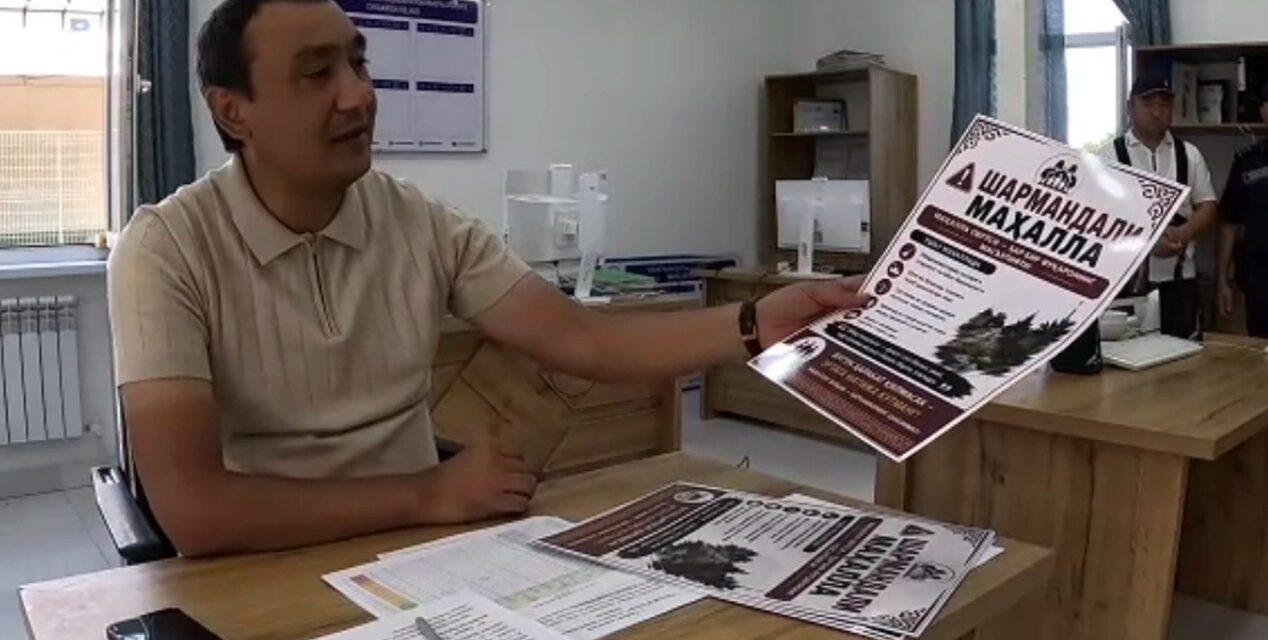
Another video, originally published by the Chinaz district administration on July 27 and subsequently deleted, showed district hokim Sherzod Salikhov displaying signs bearing the words “Shameful Mahalla” and “Shameful House.”
Salikhov instructed officials to inspect homes, take photographs and place the signs prominently on properties deemed insufficiently maintained.
After the initiative provoked public outrage, Salikhov described the signs as his personal initiative and claimed that they were intended as a form of “awareness-raising” or encouragement rather than interference in private life. He later said that officials would apologize if they were found to have acted improperly.
Other videos from different regions showed officials entering residential properties, inspecting traditional bread ovens and questioning residents about how they used them. In one recording, a woman asked officials not to film her and said that they should instead address potholes and shortages of gas and electricity.
Article 31 of the Constitution of Uzbekistan guarantees the inviolability of private life and the home. It states that no one has the right to enter a dwelling against the will of those living there and that entry and inspection are permitted only in certain cases and according to procedures established by law.
Officials may intervene when the condition of a property poses a clear danger to public health or other people. However, such intervention must have a clear legal basis, pursue a legitimate aim and be carried out in accordance with established procedures.
The condition of dishes in a kitchen, the contents of a refrigerator or an official’s personal opinion about how a courtyard should look do not, in themselves, constitute a threat to public health. Nor do they provide a lawful basis for entering a home, filming its occupants, humiliating them or imposing an administrative fine.
A paternalistic model of government
According to Uzbek Forum director Umida Niyazova, these incidents reflect an extremely paternalistic relationship between the state and its citizens.
“In such a system, government officials do not treat adults as autonomous citizens with rights, personal boundaries and the freedom to make decisions about their own lives. Instead, they regard them as dependants who must be constantly instructed on how to maintain their homes, raise their children, hold weddings, dress and live.”
These interventions are an abuse of powers by the authorities and are not part of their responsibilities. Regional and district authorities have important public duties which include the maintenance of roads, water and sewage systems, ensuring reliable electricity and gas supplies, organizing waste collection, and overseeing schools and healthcare facilities.
Residents can be fined or publicly shamed for failing to maintain their homes according to an official’s standards, yet they have virtually no effective mechanisms for holding hokims accountable for failing to carry out their official duties. Hokims are appointed rather than directly elected, leaving residents without an effective means of removing local leaders who fail to fulfil their responsibilities to the community.
Beautification and forced labor
The current inspections also reflect a longstanding practice in which local authorities mobilize residents and public-sector employees to perform tasks that should be carried out by professional, publicly funded municipal services.
In 2018, Uzbek Forum documented the systematic mobilization of teachers, doctors, nurses and other public-sector employees for street cleaning, tree planting, painting, rubbish collection and other beautification work. Some were even required to renovate private homes themselves or purchase paint, flowers, seedlings and other materials.
The report, There Is No Work We Haven’t Done, showed that these were not isolated incidents but part of an established system in which officials treated public-sector employees as a source of free labor.